Sunday, December 3, 2017

Phase 5: Speculative Representation

The insect systems are tested on variation of existing buildings to see how much they can integrate with the living units. Edible insects are not just recently came up to the industry. They are also one part of the ecosystems. Comparing to the livestock, they contain higher protein, require less feed, water and space. Meanwhile, they can be reproduced to a very high number in a very short time. So why shouldn't we war them ? Is it because we have an image of them as disgusting creatures? With the natural process, we cannot really capture their lives, their living conditions and their characteristics. But if we get to see every process of growing them, feeding them and living with them to observed every step of productions, the question is will you feel more comfortable to eat them. 


The systems are tested on variation of existing buildings to see how each context, environment and surroundings constraints the systems. How adaptive the system has to be to fit in to those context whether in a very dense urban area or a place without having any other buildings surrounding. 

Classification1: have wings
 cricket 

grasshoppper 


Classification2: have no wings

giant scorpion
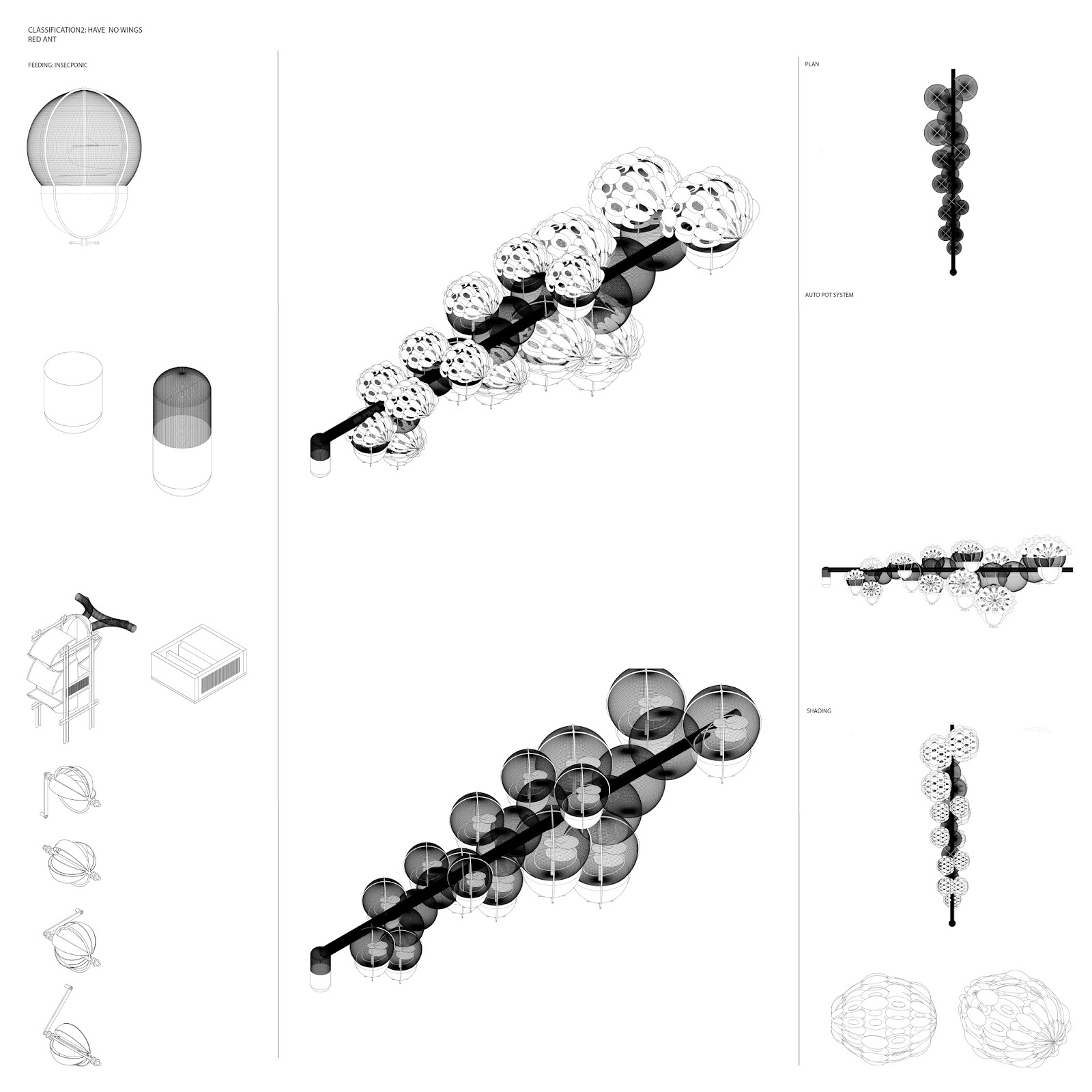
red ant


Classification3: worm
mealworm

bamboo caterpilla

The project is invited you all to reflect that every plate is counted. Everyone should consider how each ingredient is produced to become the food that is on your plate, just like the quotes that said, " you are what you eat". 


Perspective views
(suggesting how the living units are transformed)


situation1: the bomb shelter becomes a place for growing mushroom


situation2: the kitchen is plugging in with the insect system


situation3: the original living room is transformed to a kitchen in order to harvest the insects easier


Wednesday, November 8, 2017

Phase 4

" Food production "


The project has been risen up to a question of how much we can control the food production within the living units. My first approach is to test on the systems on several building in Singapore and evaluate the result. In the previous phase, insects are introduced as a substituted protein as they are far more better than the livestocks. They only require little of space and water but can give much more protein than the meat itself.  

The systems are categorised into three different parts according to the classification of insects: have wings, have no wings and worm. They are quite independent in terms of their characters and living condition. Thus, the plans are represented how the systems adapt to the living space. 

Normal HDB block

 Pearl bank building 


Skyville dawson

Skyville dawson integrating with systems 
Insect systems 


Tuesday, September 26, 2017

Phase 3: Projection

" The Sudden Change "


The diagrams are represented a comparison between a transitional change and a transformed situation. The AVA (Agri-Food and Veterinary Authority of Singapore confessed that they have made a mistake. There are some countries that deliver contaminated food to the city without their checks. People have to adapt to the sudden change. The AVA encourages them to farm their food at home. They found that insects are much more better for consumption. They can give larger amount of protein than the meat, plus they require less water and space. Both fungi (mushrooms) and insects are fast micro-production, meaning they can be growing into large number in a mean time.


The AVA sends out the leaflet around the city to encourage people to make their own food sources. 


An experimentation of growing mushroom

Wednesday, September 6, 2017

Phase 2: De-Coding The Little Red Dot

" Food Production "


Singapore’s agriculture sector has shown significant changes on the business front in the last century. As the rate of population increased rapidly, the number of farms on the other hand decreased. At the beginning of the 20th century, farming has nearly been phased-out. The country has reduced its agricultural land to only 1% of its total territory. The intensive argrotechnology park are therefore established to maxmise the output from Singapore’s limited agriculture land.

Besides, their food supply are mainly imported from the nearby countries such as Malaysia and Indonesia. The huge foodstuff demand make Singapore highly dependent on its supplying conuties. Since, the trasportation and the processing condition improved, the further countries like China and USA can export their food to Singapore very easily.

According to the development of technology, it would be interesting to think about the very near future that maybe the country can bring back their own resources.

Phase 1: Micro-Speculation

" No More Insecticide "

On the August 12th, 2017, the Staitstimes news was notified that eggs in Singapore are safe for consumptions. The eggs are from local and imported from an unaffected country, Malaysia. As may fipronil-contaminated eggs were already discovered in 15 countries, people were afraid to buy the eggs. 


Eggs react with vinegar (what we think it is clean can actually be very dirty)


Artificial egg


What will you choose to consume between the contaminated eggs or the eggs that you can actually see through all the process of what substances that the eggs really contain with?


Artificial vs. Non-artificial