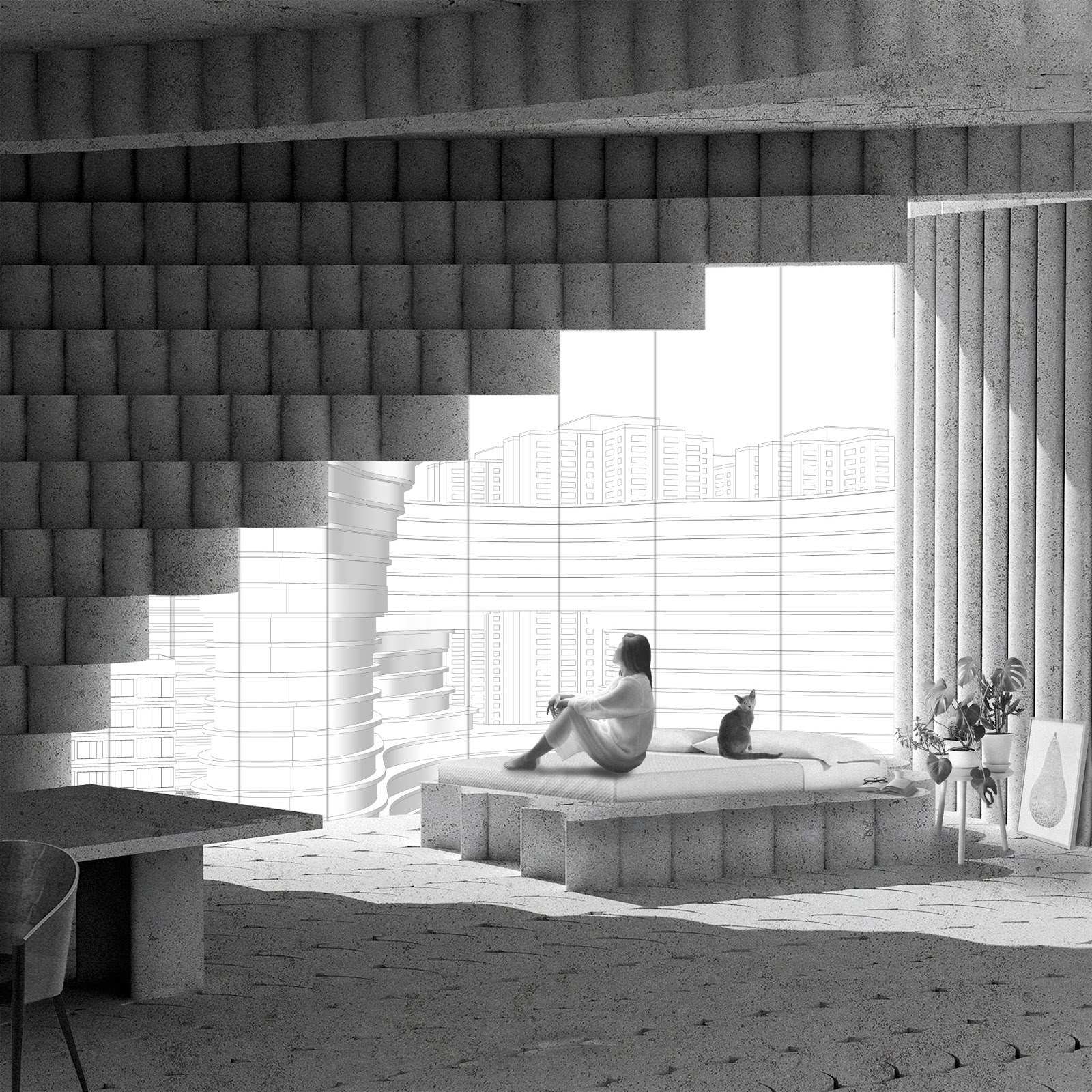
Nomadic Factory,
Singapore 2047
“Life in A World of Hyper-prefabrication”
To say that the city is expanding rapidly is an understatement. Multiple-storey structures are erected within days as the government implements an extreme buildability legislation to increase construction efficiency. In recent years, the Building Construction Authority provides tax incentive and financial support to nudge local construction firms to adopt new technologies and reduce reliance on foreign workers, who are progressively being replaced by automated machines. It seems unreal now to even imagine how such a huge number of workers used to work on a construction site- those times are long gone.

Asif Islam is a 26 year old construction worker who is in charge of riveting and bolting structural joint at Chuan Holdings Limited -a class B1 general building contractor in land sector with a tendering limit of S$40 million which means that the company mostly work on medium size office and residential towers. Like most of his co workers, Islam had sold his father’s land and pig farm and also borrowed money from banks and relatives to pay S$17,000 in fees to multiple agencies who helped arrange the job and his trip to the island state early last year. In just a few months, his employer had told him that there wasn’t enough work and he was laid off from a job directing traffic around building sites and operating excavators. People at the Ministry of Manpower urged him to find another job, but most positions are now being replaced by a new breed of construction device that now takes up most of the chores on the construction business. Still owning S$8,000, Islam has only earned S$9,000 during his time away- based on basic pay of just s$25 a day and overtime of s$5 per hour, he had no choice but to invest for an extra course to learn about metal wielding from a local contractor training center in order to secure the next available position at the company.
His uncle once told him about his life as a foreign worker in Singapore when they still had large mega-dormitory buildings where thousands of people live together in one complex. He could still recall minute details of the story where one would scan his face to go through the entrance. Fortunately for him, the dormitory life was great- they cook together, play cricket or watch movies for free at the outdoor cinema in their free time and earning five times more than they would back home. Despite coming from a remote village back in his hometown, his uncle has no trouble adjusting to the new city life. Everytime he thinks back it all feel like a distant dream to now. He knows that his life would change dramatically as he decides to step foot to work in this industry. Although relieved that all his investment and hard training had paid off to secure him this new position that many people desire, he still feels a looming sense of uncertainty at the pit of his stomach- how long will he be able to keep this new position until a newer and more clever machine replace him?

Speaking of the machine- it seems like a nomadic factory that never sleeps. It moves to the construction site around the city to produce prefabricated building parts and eats up the old ones to reconstruct a new future. A team of robots and human sprawl out of this mothership like insects to complete one structure as they carry on to the next one. Life inside a machine is unlike any place he used to live- from the outside it doesn’t seem like a space where human can live- a central core rises up from the inside formed by all the mess of ductwork, wires, pipe, condensing units and exchanging valve. There are no windows or any light openings either except from a circular gap between a large machine core and external hydraulic pistons. At the base of the structure, multiple robotic arms create and assemble prefabricated building parts sometimes from the excavated material. As he enters the control room above the main assembly line, the interior is lit by control panel lights his living quarter is located deep behind the cluster of these equipments. The constant echo of humming machinery often wakes him up in the middle of the night. It took Islam a while to get used to his miniature cubicle that he shares with two other workers. The work usually falls on a eight hour shift and the three of them take turns to keep the machine running 24 hours a day, 7 days a week.
Not even Islam or any of his co workers really understand how the machine operates, as their job is just to make sure that everything functions normally. Regular safety trainings and procedures are given to them prior and during employment by their boss- an automated engineer who occasionally comes to program the whole process. Islam has heard that the company is working on a new component that will soon replace him any day now.